

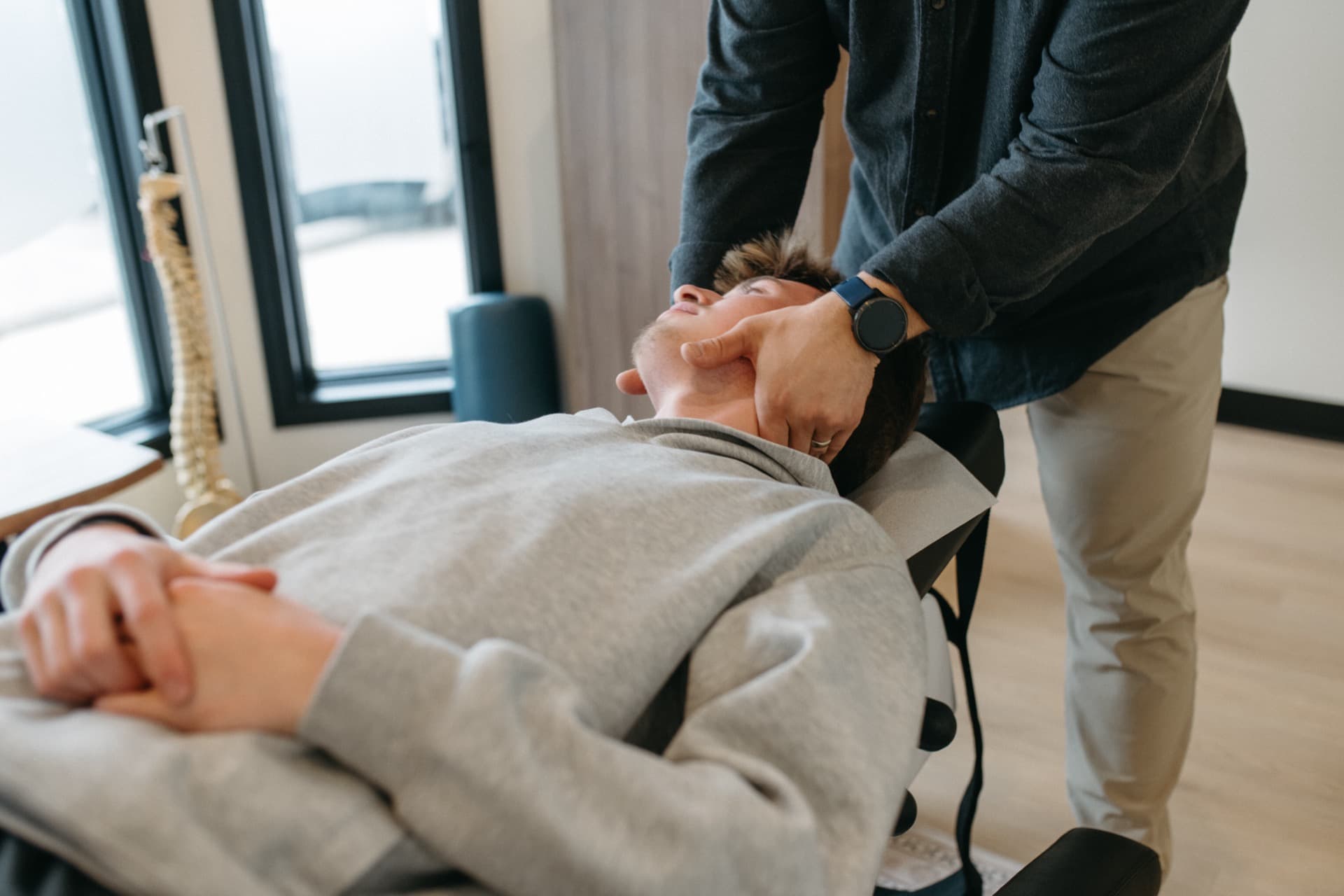
A Chiropractic Adjustment Isn't About Cracking Your Back. Here's What It's Actually About.
Spinal manipulation is one of the most researched conservative treatments for musculoskeletal pain. Understanding what it does, and why, helps you get more out of every visit.
Also in Patient Resources
Why Joint Restriction Becomes a Cycle, and How an Adjustment Breaks It
When a spinal joint stops moving the way it should, whether from injury, prolonged posture, accumulated strain, or simply time, the surrounding muscles tighten to compensate. Inflammation builds. Nerves in the area become irritated. The body guards the area, which restricts movement further, which generates more irritation. What begins as occasional stiffness becomes a pattern that the body maintains even after the original cause has resolved. A chiropractic adjustment is a precise, controlled movement applied to a specific joint to restore its normal range of motion and interrupt that cycle. It does not force anything. What it does is restore mobility to a joint that has lost it. That change, applied at the right joint, in the right direction, at the right time, allows the downstream effects to begin to unwind. This is why an accurate assessment before any adjustment is not optional. The technique has to match the diagnosis. At Summit Spine Centre, we do not adjust blindly, and we will never treat a patient whose presentation we have not evaluated.
What You Should Know About Chiropractic Adjustments
Most patients arrive with questions they did not know how to ask. These are the things that matter most.
What Happens in the Joint
A chiropractic adjustment, also called spinal manipulation, applies a short, precisely directed force to a restricted joint. This restores normal movement, reduces the muscular guarding around the joint, and decreases the local inflammatory response. The nervous system responds immediately: pressure on nearby nerve roots is reduced, and the brain receives updated positional information from the joint. This is why many patients feel not just local relief but a broader sense of ease in the surrounding area within minutes of a well-placed adjustment.
What the Sound Is, and Isn't
The pop or click that sometimes occurs during an adjustment is the release of dissolved gas from the joint fluid, the same mechanism as cracking your knuckles. It is harmless. It is not bones grinding, or any indicator of a successful treatment. Not every adjustment produces a sound, and the sound itself has no clinical significance. If the noise makes you nervous, tell us. There are adjustment techniques that produce little or no audible release and are just as effective.
Conditions That Respond Well
Chiropractic adjustments are among the most researched conservative treatments for low back pain, recommended as a first-line intervention before medication by the American College of Physicians. They also have strong clinical evidence for neck pain, cervicogenic headaches, sciatica, and hip and pelvic pain. More broadly, any condition where restricted spinal joint mobility is a contributing factor tends to respond. This includes presentations that have been building for years, not only acute injuries.
Assessment First, Every Time
Before any treatment at Summit Spine Centre, we conduct a thorough assessment: your history, a physical and orthopaedic examination, and where indicated, a review of imaging. This is not a formality. Different spinal conditions require different techniques, different directions, and different levels of force. A disc herniation is not treated the same way as a facet joint restriction. An acute inflammatory flare is not managed the same way as a chronic mobility deficit. Knowing the diagnosis is what makes the treatment targeted rather than generic.
The Techniques We Use
We adapt our approach to the patient, not the other way around. Diversified adjustment is the most common technique: high-velocity, low-amplitude, precisely applied. Cox Flexion-Distraction is a specialized low-force decompression technique we use for disc herniations, stenosis, and patients who are not candidates for high-velocity manipulation. Instrument-assisted adjustment is available for patients who prefer a gentler approach. The technique is a clinical decision, not a patient preference, though your comfort is always part of that conversation.
What to Expect After an Adjustment
Many patients feel immediate relief: reduced tension, easier movement, a sense of lightness in the treated area. Some experience mild soreness in the 12 to 24 hours following, particularly after the first few visits when the joints are moving in ways they have not for some time. This is normal and resolves quickly. Staying hydrated, doing any prescribed exercises, and avoiding prolonged static postures on the day of treatment all support a faster response. If you experience anything that feels unusual or significantly worsens, contact us. We want to know.
What Adjustments Deliver Beyond the Visit
The effects of a well-applied adjustment extend beyond the table. Here is what the evidence and 35 years of patient outcomes show.
Restored Joint Mobility
The most direct outcome of a chiropractic adjustment is the restoration of movement to a restricted joint. Patients describe this as stiffness lifting, a range of motion returning that they had stopped noticing was gone, or simply moving more easily than they have in months. That restored mobility changes how the surrounding muscles load the joint and how the nervous system reads its position, both of which have downstream effects on pain and function.
Reduced Nerve Irritation
Many pain presentations involve nerve compression or irritation, including the leg symptoms of sciatica, the arm tingling of cervical radiculopathy, and the headaches that begin in the upper neck. Adjustments reduce the mechanical pressure on affected nerve roots by restoring the joint space and reducing the inflammatory load in the surrounding tissue. Patients often report that referred symptoms, such as pain or tingling into the limbs, begin to centralize toward the spine and then resolve over subsequent visits.
Faster Recovery When Combined With Exercise
Adjustments and targeted exercise are not alternatives. They are sequential. An adjustment restores mobility. Exercise builds the muscular support needed to hold that mobility between visits. Patients who combine regular adjustments with a prescribed home exercise program recover measurably faster than those who rely on either approach alone, and they have significantly lower re-injury rates. This is why we give every patient a take-home program and why we treat the exercise component as seriously as the in-clinic treatment.
Fewer Visits Over Time
The goal of care at Summit Spine Centre is to need us less, not more. Patients who get accurate diagnoses early, follow their home programs, and make the lifestyle and ergonomic changes we recommend typically require a small, finite course of care and then return infrequently for maintenance. Open-ended, indefinite treatment is not the model. We will always give you an honest timeline and a clear picture of what we are working toward, and we measure success by how well you are doing when you are not in our office.
What Happens From Your First Call to Your Last Visit
There are no surprises at Summit Spine Centre. Here is exactly what to expect.
Book and Prepare
No referral required. Call us or book online and we will get you in when it works for you. Wear comfortable clothing. Bring any relevant imaging if you have it: X-rays, MRI reports, previous diagnoses. If you have had prior treatment for the same complaint, note what helped and what did not. That information shapes the assessment.
Thorough Assessment
Your first appointment is 30 to 45 minutes. We take a full history, perform an orthopaedic and neurological examination, and identify the specific joints, nerves, or structures involved. We explain what we find in plain language. You will leave the first visit with a clear understanding of what is causing your pain and a proposed care plan, not a vague commitment to "a few visits and see how it goes."
Treatment Begins
Subsequent visits start now, and we focus on restoring motion to those restricted joints. The adjustment is applied to the specific joints identified in your assessment, using the technique most appropriate for your condition. You will always know what we are doing and why.
Home Support and Discharge
Depending on the condition, we may provide additional information such as exercises and stretches, ergonomic suggestions, or other lifestyle recommendations. As your symptoms resolve and function improves, visit frequency decreases. Discharge is when you have met your goals, not when the clinic decides to keep you coming. Many patients choose to return for periodic maintenance visits; others do not need to. Both outcomes are a success.
Is chiropractic care safe?
Yes. Chiropractic adjustments are among the safest treatments available for musculoskeletal pain. Serious adverse events are extremely rare, and the risk profile compares favourably to long-term NSAID use or other pain management approaches. At Summit Spine Centre, every patient is fully assessed before treatment begins. We do not adjust without understanding the clinical picture, and we adapt our technique to the patient's age, condition, and comfort.
Does an adjustment hurt?
Most people find adjustments relieving rather than painful. Some experience mild local soreness in the 12 to 24 hours following their first few visits, similar to how muscles feel after exercise you haven't done in a while. This is normal and temporary. If you are nervous, tell us before we begin. We will walk you through exactly what we are doing, and we can use lower-force techniques if that is more comfortable for you.
How many adjustments will I need?
It depends on what is causing your pain, how long it has been present, and how your body responds. Some patients with acute, recent-onset problems feel significantly better within three to five visits. More complex or long-standing conditions require longer care. We give you an honest estimate at your first appointment, not an open-ended plan. If you are not responding as expected, we tell you and adjust the approach.
Do I need a referral from my doctor?
No. In Alberta, chiropractors are primary care providers. You can book directly without a referral from a physician or any other health professional. If your presentation warrants imaging or a specialist referral, we will initiate that from our end.
Is chiropractic care covered by insurance in Alberta?
Most extended health benefit plans in Alberta include coverage for chiropractic care. Check your specific plan for annual limits and per-visit amounts. We do not direct bill, but we provide a detailed receipt with all the information you need to submit your claim quickly.
How is a chiropractor different from a physiotherapist?
Both professions treat musculoskeletal conditions, but the training, diagnostic focus, and primary tools differ. Chiropractors complete a four-year post-graduate doctorate program with a specialty in spinal diagnosis and manipulation. At Summit Spine Centre, spinal health is the only thing we treat. It is our area of deep clinical expertise. We also offer Cox Flexion-Distraction, a specialized decompression technique not available at most physiotherapy or chiropractic clinics in the area.
Ready to Understand What's Actually Going On in Your Spine?
Most people wait far longer than they need to before getting assessed. The longer a spine problem goes unaddressed, the more the surrounding structures adapt to it, and the more complex recovery becomes. Same-week appointments available. No referral required.